
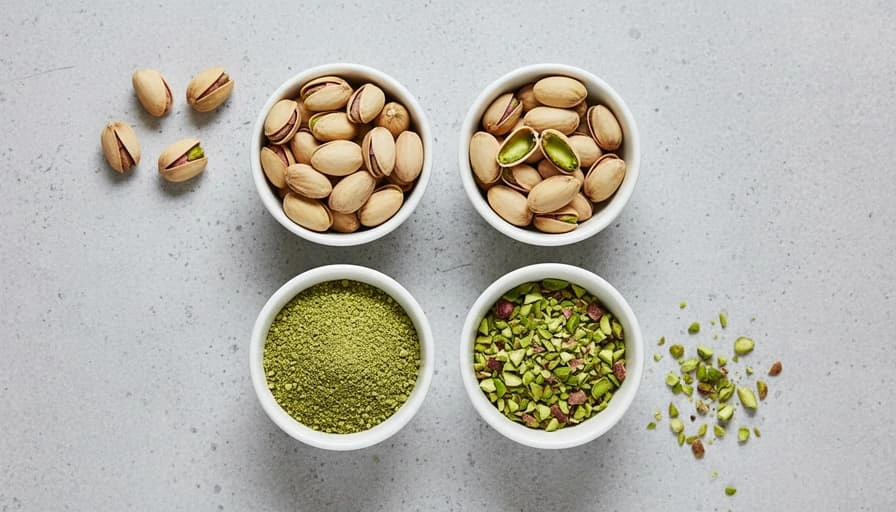
For any business buying pistachios at scale, the wholesale pistachio price is one of the hardest numbers to pin down — and one of the most consequential. Two suppliers can quote figures that look far apart, yet describe completely different products, which makes a bare price almost meaningless without context. Pistachios are among the most expensive tree nuts on the market, so even a small shift in the price you pay moves the cost of every product you make.
This guide explains what actually drives the wholesale pistachio price, how to read and compare quotes fairly, and how to budget and time your orders. It builds on our broader B2B guide to sourcing wholesale pistachios, and connects to our look at how bulk buying saves costs. The goal is not a single number — prices move constantly — but a framework that lets you understand any quote you receive.
In short: what determines the wholesale pistachio price
The wholesale pistachio price is set by origin, grade, form, order quantity, harvest season, global demand, and packaging and shipping. No single market figure applies to every product, because each of these factors changes the cost. The most accurate price comes from a specific quote for a defined product, quantity, and destination — and the fairest comparison is always between matched specifications.
The main factors that drive wholesale pistachio prices
Before comparing any quotes, it helps to understand the levers that move the price. Each factor below can shift the cost on its own, and they often combine — which is why two quotes are rarely comparing the same thing. Reading a price through these factors turns a confusing number into useful information.
| Factor | Effect on price |
|---|---|
| Origin | Syrian is typically premium-priced; American is competitive at volume |
| Grade | Higher grades cost more for better color, size, and uniformity |
| Form | Forms needing extra processing (granulated, slices) cost more |
| Quantity | Unit cost usually falls as order volume rises |
| Season | Prices move with harvest timing and post-harvest availability |
| Global demand | Demand waves and supply pressure push prices up |
| Packaging & shipping | Packaging type and destination feed into the landed cost |
The rest of this guide takes the most important of these factors in turn, so you can see not just that they matter, but how they change a quote and what to do about it.
Why origin changes the price
Origin is one of the biggest price drivers. Syrian (Aleppo) pistachios are usually priced as a premium product, sought for their flavor and color, while American (California) pistachios are more competitive at large volume thanks to scale and uniformity. Neither is simply cheaper — they price differently because they serve different purposes in a product.
Origin sets a baseline for the price before grade and form even enter the picture. Syrian pistachios command a premium because their intense flavor and deep color are valued where the nut is visible and central, and because their supply is more specialized. American pistachios, grown at large scale, tend to be more competitive for high-volume orders where uniformity matters more than a distinctive regional character.
This is why comparing a Syrian quote to an American quote on price alone is misleading — they are different products with different roles. For the full comparison across flavor, supply, and use, see our guide to Syrian and American pistachios. Many manufacturers buy both, directing each origin to the products it suits and managing cost across the two.
How grade and form affect price
Grade and form both move the price. Higher grades cost more because they deliver better color, size, and uniformity, which matters most when the pistachio is visible. Form changes price through processing: in-shell and whole kernels are closer to raw, while granulated and slices require extra work. Matching grade and form to the product avoids paying for quality you do not need.
Grade and form are where buyers most often overspend or underspecify. A premium grade is worth it when the pistachio shows on the surface of a product, but a lower grade can be perfectly suitable for fillings where appearance is hidden. The same logic applies to form: extra processing adds cost, so the right form is the one the product actually needs.
| Specification | Lower cost | Higher cost |
|---|---|---|
| Grade | Food-industry / commercial grade | Premium grade |
| Form | In-shell, whole kernels | Granulated, slices |
| Best fit | Hidden uses, fillings, scale | Visible, premium products |
To match these to your product line, see our guides on choosing the right pistachio grade , pistachio product forms, and pistachio sizes. Specifying grade and form precisely is one of the simplest ways to control the price you pay.
How order quantity changes unit cost
Order quantity is a direct lever on unit cost. As volume rises, the price per kilo usually falls, because larger orders improve purchasing terms and spread fixed costs across more product. This is the core reason bulk buying is more efficient for manufacturers, and why planning orders ahead can secure both a better price and steadier supply.
Quantity is the lever most directly within your control. Buying in larger volumes typically lowers the unit price, which is why consolidating orders or planning purchases ahead of need tends to beat frequent small buys. The trade-off is storage and cash flow, so the right volume balances the unit-cost saving against how much you can hold and use before quality declines.
This relationship between volume and price is covered in detail in our guide to how bulk pistachio buying saves costs. For most factories, planning quantity around production cycles is the single most effective way to manage the wholesale pistachio price over a year.
Season, harvest, and global demand
Season and demand move the price beyond any single buyer’s control. Pistachios are harvested once a year, so availability and price shift with the harvest cycle, and trees tend to bear in alternating heavy and light years. On top of that, global demand waves — including viral pistachio products — and tightening supply have pushed prices up in recent seasons.
Season and global demand are the factors a buyer cannot negotiate, only plan around. Pistachios are harvested annually, and the trees are known for alternate bearing — heavier crops one year, lighter the next — which feeds into year-to-year availability. Prices typically ease after harvest and tighten as stocks draw down and demand peaks.
Demand has added pressure of its own. Waves of popular pistachio products have lifted global demand sharply, and overall pistachio prices have risen while supply has tightened in recent seasons. For market context, see our overview of pistachio supply trends, and for authoritative production data you can consult the US Department of Agriculture (USDA). The practical response is to buy ahead of peak demand rather than into it.
Packaging, shipping, and landed cost
Packaging and shipping turn a price at origin into a landed cost. Packaging type, shipping destination, transport mode, and any temperature control all add to what you ultimately pay. A quote that excludes these can look cheaper than one that includes them, so always confirm what a price covers before comparing offers.
The price at origin is not the price you actually pay. Packaging, freight, and any temperature-controlled handling all add to the landed cost, and they vary with destination and transport method. This is where quotes most often become unfair comparisons — one may be a bare product price while another includes packaging and delivery.
- Packaging: bulk sacks cost less per kilo than smaller bags or custom packaging.
- Shipping mode and distance: sea, air, and road differ in cost and speed, and distance adds up.
- Temperature control: cold-chain handling protects quality but adds cost on long or warm routes.
- Duties and clearance: import duty and clearance costs depend on destination and classification.
Always clarify what a quote includes — product only, or product plus packaging and delivery — so you are comparing landed costs, not mismatched figures.
How to read and compare pistachio quotes
Because so many factors feed into the price, the only fair way to compare quotes is to make sure they describe the same thing. A complete quote should specify every variable that affects the price, so you can line up offers on equal terms instead of being misled by a low headline number that hides a lower specification.
| A complete quote should specify | Why it matters |
|---|---|
| Origin (Syrian or American) | Sets the baseline price and product role |
| Grade | Defines the quality tier you are paying for |
| Form | Reflects processing and intended use |
| Quantity and unit | Determines the unit cost and total |
| Packaging | Affects both cost and protection |
| Delivery terms and destination | Shows whether shipping is included |
| Documentation included | COA, aflatoxin testing, origin, and more |
If a quote leaves any of these blank, the price is incomplete. Ask the supplier to fill in the gaps before comparing, and treat a fully specified quote as more trustworthy than a vague one that happens to look cheaper.
How to budget and lock in pricing
To budget for pistachios, plan purchases around production cycles and buy ahead of peak demand to avoid the highest prices. Securing quantities in advance, and working with a supplier who offers more than one origin, helps stabilize both cost and supply. The aim is predictable pricing across the year rather than reacting to spot prices at the worst moment.
Budgeting for pistachios is about timing and planning more than chasing the lowest spot price. Buying ahead of harvest peaks and high-demand seasons protects both price and availability, while last-minute orders during a peak tend to be the most expensive and the least reliable. Planning around your production calendar smooths cost over the year.
Working with a supplier who can offer both Syrian and American pistachios also helps, because it lets you shift between origins as price and availability change, and reduces dependence on a single source. A stable supplier relationship usually delivers more predictable pricing than constantly switching to whoever is cheapest in a given week.
Common pricing mistakes
A few recurring mistakes lead buyers to overpay or to choose the wrong product. Avoiding them is mostly about discipline in how you read and compare prices.
- Comparing unmatched specs: judging quotes on price without checking origin, grade, and form leads to false savings.
- Ignoring landed cost: focusing on the product price and overlooking packaging, shipping, and duties.
- Buying at the peak: delaying orders into high-demand seasons when prices and scarcity are highest.
- Overspecifying grade: paying for premium quality in products where the pistachio is hidden.
- Chasing the lowest price: switching constantly to the cheapest supplier and sacrificing consistency and supply security.
The underlying principle is that the cheapest quote is rarely the best value. The right wholesale pistachio price is the one that matches your product’s needs at a quality and supply level you can rely on.
Why Alyassin Farms?
At Alyassin Farms, we price wholesale pistachios against a clear specification rather than a vague market figure, so you know exactly what you are paying for. Our family heritage in pistachios dates to the 1970s, beginning with the family’s orchards in Syria, which means we understand the product from the source and can match it to your product and budget.
We supply both Syrian and American pistachios, supported by our office in Seattle and direct relationships with California farms, with multiple grades, forms, and flexible packaging. We work exclusively in wholesale supply for confectionery and chocolate manufacturers, bakeries, and distributors, and provide paid samples with photos and video so you can confirm quality before committing. Request a quote based on your exact product, quantity, and destination for an accurate price.
Frequently Asked Questions
How much do wholesale pistachios cost?
There is no single price, because cost depends on origin, grade, form, quantity, season, and shipping. The most accurate figure comes from a specific quote for your defined product, quantity, and destination, which lets the supplier price exactly what you need rather than a generic average.
Why are pistachios so expensive?
Pistachios are a high-value tree nut grown in limited regions, with trees that take years to mature and tend to bear in alternating heavy and light years. Combined with strong global demand and processing requirements, this keeps pistachios among the more expensive nuts.
Are Syrian pistachios more expensive than American?
Syrian (Aleppo) pistachios are usually priced higher as a premium product, valued for their flavor and color, while American (California) pistachios are more competitive at large volume. The right choice depends on the product, not just the price, since each origin serves a different purpose.
Does buying in bulk lower the price?
Yes. Unit cost typically falls as order volume rises, because larger orders improve purchasing terms and spread fixed costs. The trade-off is storage and cash flow, so the best volume balances the unit-cost saving against how much you can store and use while it stays fresh.
When is the best time to buy pistachios for a good price?
Prices generally ease after the annual harvest and tighten as stocks draw down and demand peaks. Buying ahead of high-demand seasons, rather than during them, tends to secure a better price and more reliable availability for your production needs.
How do I get an accurate pistachio price quote?
Specify the origin, grade, form, quantity, packaging, and destination, and ask which documentation is included. A fully specified request lets the supplier give an accurate, comparable price. You can start through our contact page with these details.