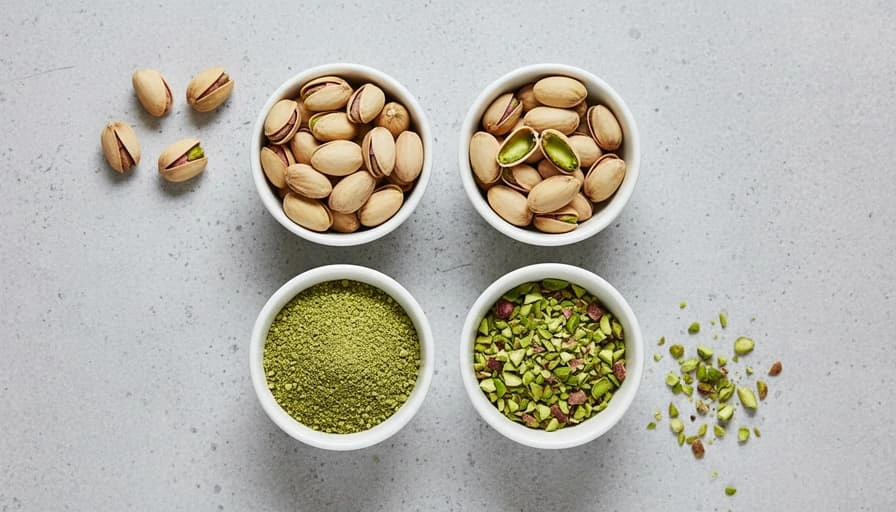
Pistachios don’t come in a single shape. They are supplied in several pistachio forms — from whole in-shell nuts to kernels, halves, granulated pieces, and fine slices — and each form has an ideal use, cost, and appearance in the finished product. Choosing the right form is just as important as choosing the right origin and grade, because it directly affects how the pistachio is used and how much your product costs.
This guide walks through the five main pistachio forms, the best use for each, how to choose the right form for your product, and how form affects storage and shelf life. It works alongside our guides on pistachio grades and Syrian and American pistachios.
What are the main pistachio forms?
The main pistachio forms are in-shell pistachios, kernels (shelled whole nuts), halves, granulated pistachios, and slices. In-shell and whole kernels suit snacking and visible decoration; halves balance appearance and cost; granulated and slices suit coating, filling, and decoration. Each form fits different production needs and price points.
As pistachios move from in-shell to more processed forms, they generally cost more to process but become easier to use directly in production. The right choice depends on where and how the pistachio appears in your product, which is why understanding all five pistachio forms helps you specify exactly what you need.
In-shell pistachios
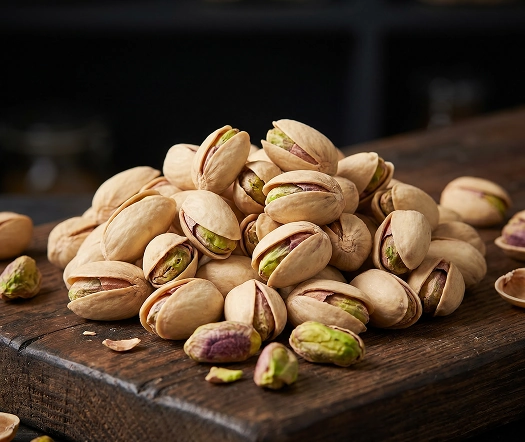
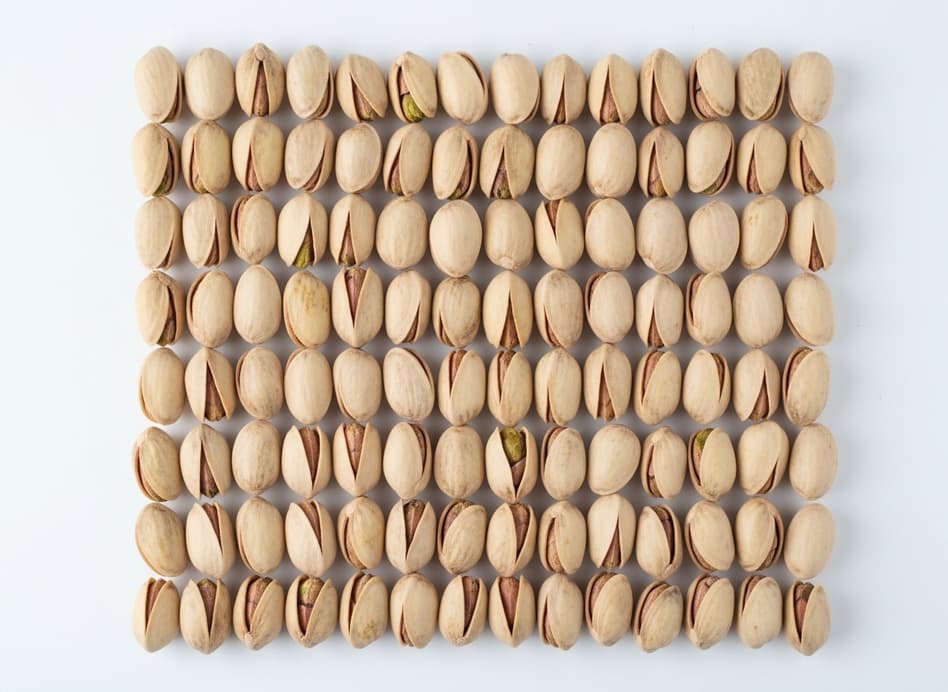
In-shell pistachios are whole nuts still in their natural shell. They are the least processed form and the most common for snacking, roasting and salting, and retail packaging. For manufacturers, in-shell is mainly relevant when the shell is part of the product or when further shelling is done in-house. Because they are the least processed, in-shell pistachios are typically the lowest-cost form per kilogram of raw nut.
Pistachio kernels
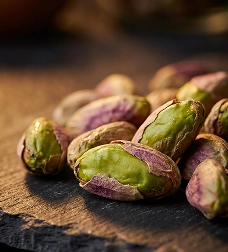
Pistachio kernels are whole nuts with the shell removed. This is one of the most versatile pistachio forms, ready to use directly in production without shelling. Whole kernels are ideal where the pistachio is visible and appearance matters — premium chocolate, decoration, and high-end sweets — because they keep their full shape and color. For visible, premium products, whole kernels are often the preferred form.
Pistachio halves
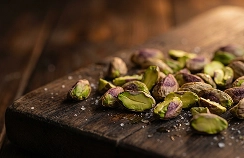
Pistachio halves are kernels split into two pieces. They offer a useful balance between appearance and cost: they still show the pistachio’s color and texture but are often more economical than perfect whole kernels. Halves are popular for fillings, toppings, and baked goods where a clean pistachio look is wanted without paying a premium for whole kernels.
Granulated pistachios
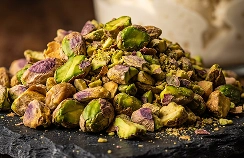
Granulated pistachios are kernels chopped or ground into small pieces. This form is widely used for coatings, fillings, and decoration where even distribution of pistachio matters more than whole-nut appearance. Granulated pistachios spread flavor and color throughout a product and are a practical choice for large-scale production, but because they are more processed they have a shorter shelf life than whole kernels.
Pistachio slices
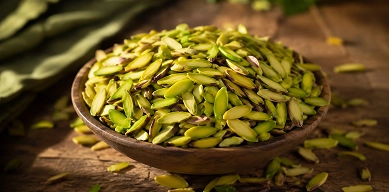
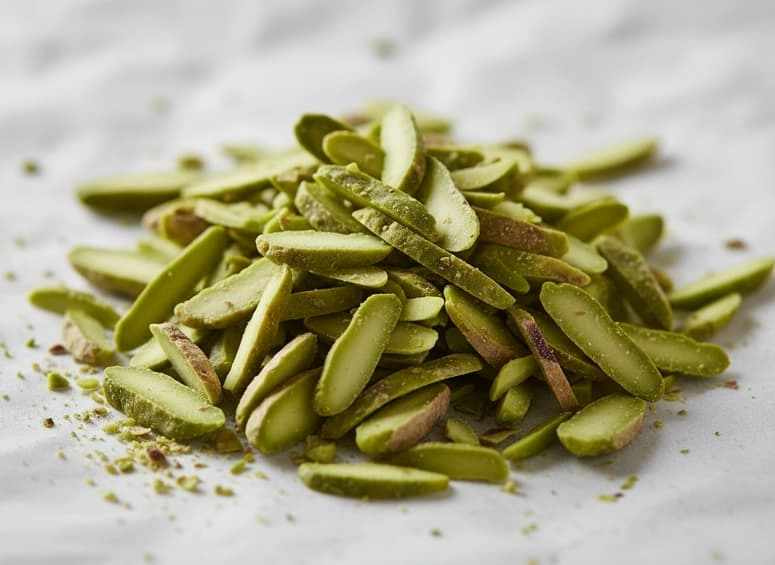
Pistachio slices are kernels cut into thin slivers. They are primarily a decorative form, used to garnish chocolate, pastries, and desserts with a refined pistachio finish. Slices deliver strong visual appeal and even coverage, which makes them popular for premium decoration, though, like granulated, their processed nature means they should be used within a shorter window.
Pistachio forms compared
| Pistachio form | Description | Best used for |
|---|---|---|
| In-shell | Whole nut in the shell | Snacking, roasting, retail |
| Kernels | Whole shelled nut | Visible, premium products |
| Halves | Kernel split in two | Fillings, toppings, baking |
| Granulated | Chopped or ground pieces | Coatings, fillings, decoration |
| Slices | Thin slivers | Premium garnish and decoration |
A note on pistachio paste
Beyond these raw forms, many manufacturers also use pistachio paste — kernels ground into a smooth, concentrated form for flavoring fillings, creams, and ice cream. While paste is a processed product rather than a raw pistachio form, it is worth knowing as an option when the goal is pure pistachio flavor rather than visible nuts. The right grade and origin still matter, since they shape the paste’s color and taste.
How to choose the right pistachio form for your product
To choose the right pistachio form, start from the role of the pistachio in your product. Use whole kernels where it is visible and premium, halves for a balance of look and cost, and granulated or slices for coating, filling, and decoration. The form should match how the pistachio is seen and used, not just personal preference.
Use these criteria to match form to product:
- Visibility: visible, premium products favor whole kernels; hidden uses suit granulated.
- Function: decoration favors slices; even distribution favors granulated; fillings suit halves.
- Cost: more processed forms can cost more, but reduce in-house labor and waste.
- Shelf life: whole forms last longer; processed forms should be used sooner.
- Grade pairing: match form with the right grade for the product.
In practice, most manufacturers use more than one of these pistachio forms across their range — whole kernels for premium lines, halves for filled products, and granulated or slices for coatings and decoration. Standardizing which pistachio form goes with each product keeps both quality and cost predictable, and makes it easier to brief suppliers and plan purchasing.
| Product / use | Recommended form | Why |
|---|---|---|
| Premium chocolate with whole nuts | Kernels | Full shape and color are visible |
| Baklava and filled pastries | Halves | Good look at balanced cost |
| Coated and dusted products | Granulated | Even pistachio distribution |
| Dessert and chocolate garnish | Slices | Refined decorative finish |
| Creams, fillings, ice cream | Paste or granulated | Flavor over visible nuts |
Storage and shelf life by form
Storage needs vary by pistachio form. Whole in-shell and kernels keep longest, while processed forms like granulated and slices have a shorter shelf life because more surface area is exposed. Store all forms cool, dry, sealed, and away from light, and use processed forms sooner to protect flavor and quality.
When planning purchases, factor shelf life into the form you buy. Buying large quantities of processed forms you can’t use quickly leads to waste, so align order size with how fast each form is consumed — a key point in our guide to bulk pistachio buying. Whatever the form, ensure storage meets Saudi Food and Drug Authority (SFDA) food-safety requirements to preserve quality.
Why Alyassin Farms?
At Alyassin Farms, we supply Syrian and American pistachios in all the main pistachio forms — in-shell, kernels, halves, granulated, and slices — backed by a family heritage in pistachios dating to the 1970s. We help you match the right form, grade, and origin to each product so it performs and costs exactly as it should.
We work exclusively in wholesale supply for confectionery and chocolate manufacturers, bakeries, and distributors, and we provide paid samples with photos and video so you can see each form before you order. Browse our products or contact us to discuss the right pistachio form for your product line.
Frequently Asked Questions
What are the main pistachio forms?
The main pistachio forms are in-shell pistachios, kernels, halves, granulated pistachios, and slices. In-shell and kernels suit snacking and visible use, halves balance look and cost, and granulated and slices suit coating, filling, and decoration.
Which pistachio form is best for chocolate decoration?
For chocolate decoration, slices and whole kernels are often preferred — slices for a refined garnish and kernels where whole, visible nuts add premium appeal. Granulated pistachios work well when even coverage across the surface is the goal.
What’s the difference between pistachio halves and granulated?
Pistachio halves are kernels split in two and still show the nut’s shape and color, suiting fillings and toppings. Granulated pistachios are chopped into small pieces for even distribution in coatings and fillings, where whole-nut appearance is not needed.
Do processed pistachio forms have a shorter shelf life?
Yes. More processed forms such as granulated and slices have more exposed surface area, so they have a shorter shelf life than whole in-shell or kernels. Store them cool, dry, sealed, and away from light, and use them sooner.
Is pistachio paste a pistachio form?
Pistachio paste is a processed product made by grinding kernels into a smooth, concentrated form, rather than a raw pistachio form. It is used for pure pistachio flavor in creams, fillings, and ice cream, where visible nuts are not required.
How do I choose the right pistachio form for my product?
Match the form to how the pistachio is seen and used. Choose whole kernels for visible premium products, halves for balance, and granulated or slices for coating, filling, and decoration, while pairing the form with the right grade and origin.