Pistachio paste is one of the most premium ingredients in confectionery and chocolate, and its quality is decided long before grinding — in the nut itself. Any manufacturer sourcing bulk pistachio paste, or producing it in-house, soon discovers that the final result in color, flavor, and texture is determined upstream, by choosing the right raw pistachios in the right origin, grade, and form. Controlling paste quality means controlling your pistachio supply.
At Alyassin Farms we don’t sell finished paste — we supply the premium raw pistachios that the best paste is made from, for confectionery, chocolate, and bakery manufacturers. Drawing on our work with these producers, this guide answers the question every paste maker faces: which pistachios are best for high-quality paste, and how do you balance quality against cost when buying in volume? If you buy in large quantities generally, our guide on buying pistachios in bulk is a useful companion.
We’ll start with a working definition of paste, then move step by step through origin, form, and grade, the factors that drive quality, the safety and compliance requirements, and the common mistakes that turn a whole batch into a loss.
What is pistachio paste, and why does its quality start with the nut?
Pistachio paste is the result of grinding pistachio kernels into a smooth, uniform paste, sometimes with light roasting or a little added oil or sugar. Because it is made almost entirely of the pistachio itself, with nothing to mask defects, its quality is a direct reflection of the nut: its color, flavor, freshness, and grade. Any flaw in the raw pistachio shows up magnified in the paste.
Unlike products where pistachio is a secondary ingredient whose flavor is covered by others, paste exposes the nut completely. There is no heavy sugar or cocoa to hide a dull-colored, weak-flavored, or stale pistachio. Paste is also distinct from the smoother, sweeter pistachio cream used in fillings and spreads. That makes paste the most sensitive of all pistachio products to raw-material quality — and the most rewarding when the nut is excellent.
In practice, this means your most important decision as a paste producer is not your grinding equipment — it is your pistachios: which origin, which grade, which form, and which supplier. The rest of this guide is dedicated to exactly those decisions.
Which pistachios are best for pistachio paste: Syrian or American?
For premium paste sold on color and flavor, Syrian (Aleppo) pistachios stand out for their deep green color and rich taste. For large-scale production with consistent specifications and a competitive cost, American (California) pistachios are better suited thanks to their uniformity and steady supply. Many manufacturers use both, depending on the type of paste and the production line.
Origin matters more in paste than in many other products, because paste highlights the characteristics of the nut so clearly. Syrian pistachios give a deep-green paste with a rich flavor, making them ideal for premium chocolate and products where the paste is the star. American pistachios give a uniform color and texture, practical for fillings and high-volume, repeatable production. You can review the full comparison in our guide on Syrian vs American pistachios.
| Criterion | Syrian pistachios for paste | American pistachios for paste |
|---|---|---|
| Color | Deep green, prized in premium paste | Lighter to medium green |
| Flavor | Rich, deep, and distinctive | Balanced and milder |
| Consistency | Varies slightly by season | Highly uniform and stable |
| Availability | Seasonal; needs a capable supplier | Year-round and steady |
| Cost | Higher, as a specialty product | Competitive, especially at volume |
| Best for | Premium paste sold on color and flavor | Large-scale, spec-consistent production and fillings |
The practical rule: if the paste is the face of your product and is sold on its character, Syrian pistachios are worth the price premium. If the paste is an internal component inside a filling or a high-volume product, American pistachios give you stability and a better cost. And there is nothing wrong with blending the two to balance flavor against cost.
Which form of pistachio should you choose for paste?
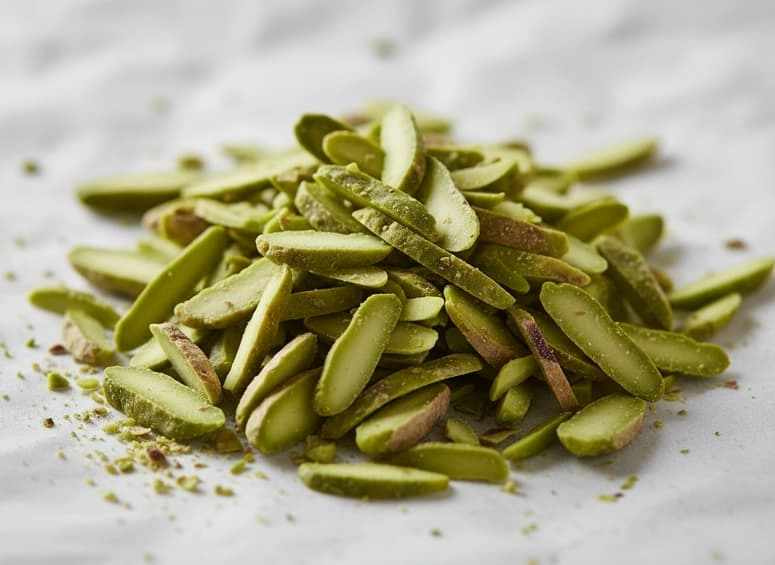
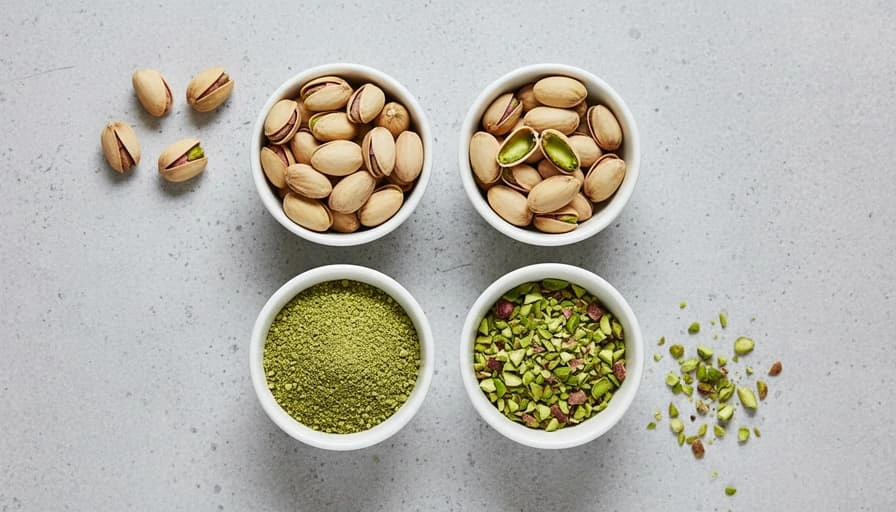
The best form for paste production is shelled kernels or halves, because they are free of shell and ready to grind directly with no waste. Granulated pistachios save a first grinding step, but watch their freshness, since processed forms have a shorter shelf life. Avoid in-shell pistachios for paste, as they require extra shelling and raise both cost and waste.
Form directly affects production cost and efficiency. Shelled kernels (whole) and halves are the ideal choice for paste: a clean kernel ready to grind, with full control over the final grind level. Pre-granulated pistachios shorten a step, but they oxidize faster, so they suit manufacturers who use them quickly. The golden rule: the less the pistachio is processed before it reaches you, the longer its shelf life and the more flexibility you keep in production.
To understand the differences between the available forms and which suits each use, see our guide to pistachio forms, which explains when to choose kernels, halves, or granulated based on your end product.
How does pistachio grade affect paste quality?
Pistachio grade determines the paste’s color, flavor, and level of impurities. Higher grades give a uniform green kernel, a purer flavor, and a more attractive paste, and are best for premium products. Lower grades can be enough when the paste is an internal component whose color is not visible, saving cost with no noticeable effect on the final product.
There is no single “ideal grade” for paste, but rather a grade suited to each use. For paste sold on its green color — such as premium chocolate fillings or decorative paste — choose a high grade with a uniform green kernel and the lowest breakage and debris. For paste used as a flavor base inside another product, you can step down a grade economically without the consumer noticing a difference. This balance between grade and cost is the heart of production efficiency.
To learn how to read grades and choose between them for your production line, our guide on choosing the right pistachio grade helps you decide with confidence.
Quality factors in bulk pistachio paste, and how to control them
Paste quality is measured by four main elements: color, flavor, texture, and purity. All of them trace back at root to the raw pistachio and how it is handled. The table below links each factor to its source in the nut and to its result in the final product.
| Quality factor | Where it comes from in the raw nut | Result in the paste |
|---|---|---|
| Color | Kernel greenness, grade, and origin | A vivid green or a dull paste |
| Flavor | Pistachio freshness, origin, and good storage | A rich flavor or a weak, oxidized one |
| Texture | Grind level and natural oil content | A smooth, uniform paste or a grainy one |
| Purity | Freedom from debris and breakage | A clean paste with no need for additives |
The two most important factors in practice are color and freshness. Green color is not added; it comes from a high-quality, well-stored pistachio, and trying to compensate for it with dyes weakens the product’s image. Freshness is the line of defense against rancidity; a pistachio stored too long or poorly will give a paste with a dull or rancid flavor no matter how well you grind it. That is why quality control begins with a supplier who guarantees fresh, well-stored pistachios.
How is pistachio paste made? The basic steps
Pistachio paste is made by grinding the kernel into a smooth paste. The grind may be preceded by light roasting to bring out flavor, or a quick blanch to remove the inner skin and brighten the color. Some manufacturers keep the paste 100% pistachio, while others add a little oil or sugar to adjust texture or taste depending on the end use.
The details differ from one manufacturer to another, but the general path runs through similar steps:
- Selecting the pistachio: deciding the origin, grade, and form suited to the paste you want — the most important step, as we have shown.
- Blanching (optional): a quick blanch to remove the inner skin if you want a clean green color and a smoother texture.
- Light roasting (optional): to enhance flavor in some pastes, being careful not to overdo it and darken the color.
- Grinding: grinding the kernel gradually to the desired texture, controlling the heat to protect color and flavor.
- Final adjustment: leaving the paste pure or adding a little oil or sugar depending on the use, then sealed packaging.
The essential point is that all of these steps preserve quality that already exists in the nut — they do not create it. Blanching, roasting, and skillful grinding will not rescue a poor pistachio, but they will reveal the best in an excellent one.
Price and volume: why bulk buying is more economical for paste makers
Paste production consumes large quantities of pistachios, because each kilogram of paste needs roughly a kilogram of kernels. That makes buying pistachios in bulk clearly more economical for paste makers: a lower unit price, consistent specifications between batches, and a stable supply that protects the production line from sudden interruptions during price spikes.
Paste is one of the most raw-material-intensive pistachio products, which makes the cost of pistachios the largest factor in the cost of bulk pistachio paste. Every reduction in the price per kilogram through buying larger quantities flows directly into your margin. A large, uniform batch also guarantees consistent color and flavor across your production, something hard to achieve with small, scattered orders that may differ from one shipment to the next. You can review the forms and quantities we offer on our products page.
Safety and compliance: what a paste maker must guarantee
Pistachios used in paste must meet food-safety requirements, the most important being aflatoxin limits, along with a certificate of analysis (COA) and a certificate of origin. Paste is a concentrated ingredient that goes into consumer products, which makes verifying the safety of the raw material a necessity, not an option — protecting the consumer and protecting your brand from risk.
Aflatoxin in particular is a sensitive issue in pistachios, and attention to it increases in concentrated products like paste. Make sure your supplier provides recent aflatoxin analyses for each batch, alongside a certificate of analysis that documents the specifications. For products sold in the United States, the raw material and finished product must comply with U.S. Food and Drug Administration (FDA) food-safety requirements, while the European Union, through EFSA, enforces some of the strictest aflatoxin limits in the world — so importers serving the EU should confirm that documentation meets those standards too.
The practical rule: do not deal with any supplier who cannot provide clear documentation. Paste quality that starts with the nut is not complete without the assurance that the nut is safe and documented from the source.
Common mistakes in bulk pistachio paste production
Many problems in bulk pistachio paste do not come from the production line but from earlier decisions when selecting the pistachio. Avoiding these mistakes saves cost and raises the quality of the final product:
- Choosing pistachios on price alone: without considering color, flavor, and freshness, producing a dull paste unfit for a premium product.
- Neglecting freshness and storage: using old or poorly stored pistachios gives a rancid paste no matter how good the grinding.
- Ignoring spec consistency: mixing different grades or origins between batches causes variation in the paste’s color and flavor.
- Over-roasting: heavy roasting darkens the desired green color and strips the paste of its premium appearance.
- Compensating for quality with additives: adding dyes or flavors to mask a poor pistachio instead of starting with an excellent one.
- Not requesting a sample and documents: committing to a large quantity without testing an actual sample and reviewing safety analyses first.
The common thread across these mistakes is that their root lies in the raw material, not the equipment. The biggest improvement you can make to your paste is to upgrade the quality of the pistachio you start with.
Why Alyassin Farms?
At Alyassin Farms, we carry a family heritage in growing and trading Aleppo pistachios that dates back to the 1970s, beginning in the family’s orchards in Syria. We do not produce finished paste; we supply the high-quality raw pistachios that the best paste is made from: kernels, halves, and granulated, from both Syrian and American origins, and in multiple grades to suit every type of paste.
We focus exclusively on wholesale supply to confectionery, chocolate, and bakery manufacturers and distributors, with paid samples accompanied by photos and video, plus certificates and aflatoxin analyses and a certificate of analysis (COA) for each batch. We help you choose the origin, form, and grade best suited to your specific paste, so you get consistent color and flavor at the best balance between quality and cost.
Frequently Asked Questions
Which pistachios are best for making pistachio paste?
The best are shelled kernels or halves with high freshness. Syrian pistachios suit premium paste for their deep green color and rich flavor, while American pistachios suit large-scale, spec-consistent production. Choosing the right grade remains a decisive factor in color and flavor.
Should I use pistachio kernels or granulated pistachios for paste?
Shelled kernels or halves are generally better, because they are free of shell and ready to grind with full control over the final texture. Granulated pistachios shorten a grinding step, but they have a shorter shelf life and oxidize faster, so they suit those who use them quickly.
What is the difference between Syrian and American pistachio paste?
Syrian pistachio paste is deeper in flavor and greener in color, suiting premium products sold on color and taste. American pistachio paste is more uniform and consistent in specification and lower in cost at volume, suiting fillings and repeatable production.
How do I keep pistachio paste green?
Green color comes from a high-quality, well-stored pistachio, not from additives. Choose a high grade with a green kernel, avoid heavy roasting that darkens the color, and store both the pistachios and the paste away from heat and light. A light blanch also helps achieve a cleaner color.
Is buying pistachios in bulk cheaper for paste production?
Yes, because paste production consumes large quantities of kernels, so the unit price in bulk buying is clearly lower. Buying in large quantities also guarantees consistent color and flavor between batches and a stable supply that protects the production line from market swings.
Does pistachio paste need additives?
Not necessarily. High-quality paste can be 100% pistachio with no additives at all. Some manufacturers add a little oil or sugar to adjust texture or taste depending on the use, but additives should never be a way to mask a weak raw pistachio.