For anyone buying pistachios at commercial scale, pistachio quality is not a matter of taste alone — it is a question of safety, consistency, and compliance that decides whether a shipment can even enter your market. A batch can look acceptable and still fail an import test or carry a hidden defect that surfaces only on your production line. Knowing what to check, and which documents to demand, is what separates a confident purchase from a costly gamble.
This guide covers how to assess pistachio quality and food safety: the attributes that define quality, why aflatoxin is the critical safety point, what a certificate of analysis tells you, and how to evaluate both a sample and an arriving shipment. It builds on our broader B2B guide to sourcing wholesale pistachios, and pairs with our guide to importing pistachios into the EU and US, where these checks meet border controls.
In short: how to check pistachio quality and safety
To check pistachio quality and safety, assess color, size, uniformity, breakage, moisture, foreign matter, and freshness, then confirm safety with documentation. The most important safety check is aflatoxin testing, alongside a certificate of analysis. Evaluate a sample before buying and inspect the shipment on arrival against the agreed specification, because visual checks alone cannot confirm a product is safe.
What defines pistachio quality?
Pistachio quality is a combination of measurable attributes, not a single trait. Each one affects how the product performs in your application and how it is valued, and together they form the specification you agree with a supplier. Understanding them lets you judge a product objectively rather than on a general impression.
| Attribute | Why it matters |
|---|---|
| Color | A vivid, consistent green signals quality and visual appeal |
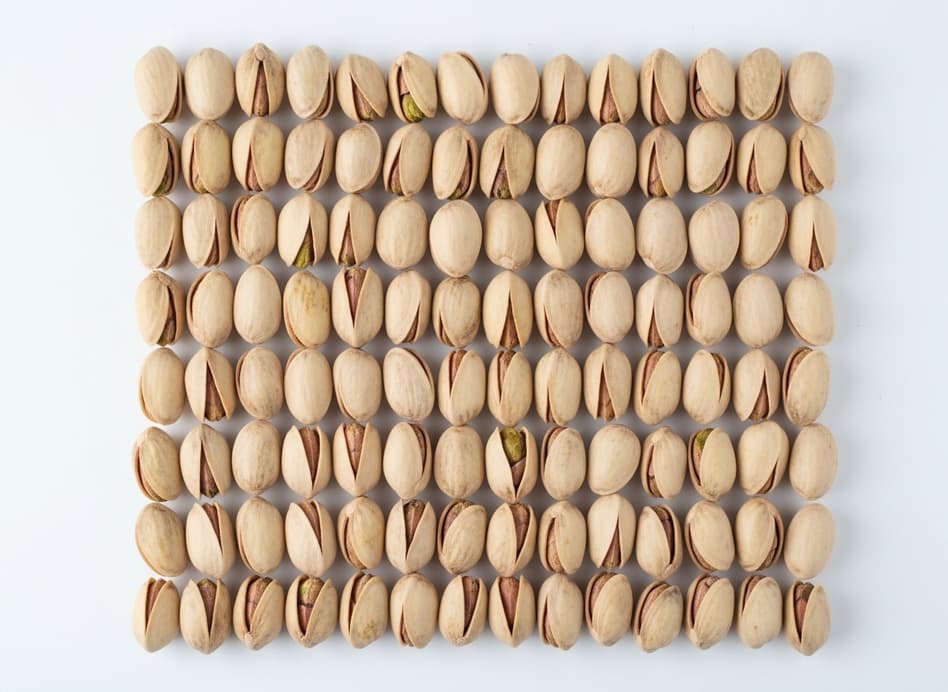
| Size and uniformity | Consistent size matters for appearance and processing |
| Breakage | A high proportion of broken kernels lowers value and usability |
| Moisture | Excess moisture risks spoilage and signals poor drying or storage |
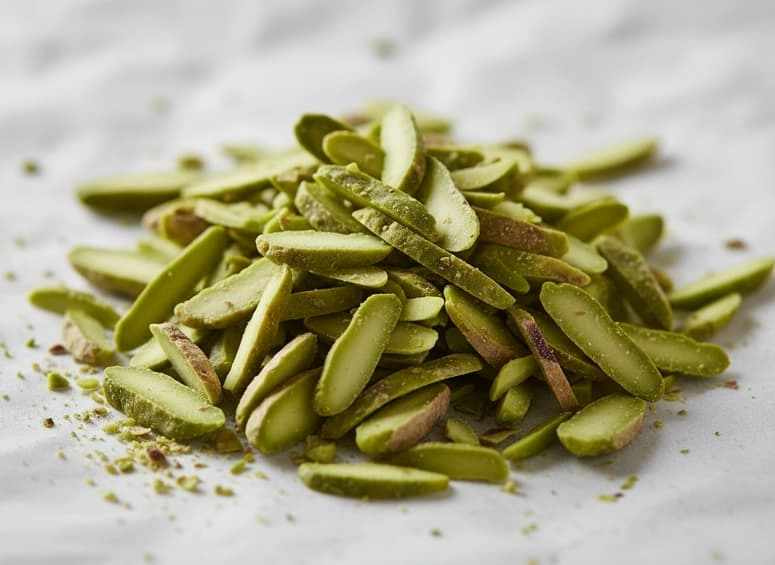
| Foreign matter | Shell fragments and debris reduce quality and yield |
| Flavor and freshness | Off or rancid notes indicate age or poor storage |
The right balance of these attributes depends on your use. A visible, premium product demands strong color and uniformity, while a filling or paste can tolerate more variation — a point covered in our guide to choosing the right pistachio grade. Quality, in other words, is always relative to the product you are making.
Aflatoxin: the most important safety check
Aflatoxin is the single most important safety check for pistachios. It is a natural toxin that can develop with poor drying or storage, and both the EU and US enforce strict maximum levels in nuts. It cannot be detected by sight or taste, so testing is essential — and a supplier who controls drying and storage and provides recent batch results is the strongest protection against a failed or rejected shipment.
Aflatoxin deserves its own section because it is both the most serious safety issue and the most common reason pistachio shipments are rejected at the border. It is a naturally occurring toxin that can form when nuts are dried or stored poorly, and crucially, it cannot be seen, smelled, or tasted. That is why laboratory testing — not inspection — is the only reliable way to confirm a batch is within limits.
Both major markets treat nuts as a higher-risk category and set firm maximum levels for aflatoxin. Because once it is present it cannot be removed from a batch, prevention at origin through correct drying and storage matters far more than testing after the fact. Confirm the current limits with the US Food and Drug Administration (FDA) for the US and the European Food Safety Authority (EFSA) for the EU, and require recent, batch-specific testing from your supplier.
The certificate of analysis (COA) and what it tells you
A certificate of analysis (COA) is a document confirming that a specific batch of pistachios meets defined specifications and safety limits. It typically reports moisture, foreign matter, and contaminant testing such as aflatoxin, tied to a batch number. The COA is your evidence that the product matches what was agreed, and it should correspond to the exact batch you are buying.
The certificate of analysis is the core quality document in a pistachio purchase. It translates the supplier’s claims into verifiable results for a specific batch, which is why it has to match the lot you are actually receiving — a COA from an older batch does not prove anything about the product in front of you. A complete COA generally covers the items below.
| COA element | What it confirms |
|---|---|
| Batch / lot number | Ties the results to a specific production lot |
| Moisture content | Confirms proper drying and storage |
| Aflatoxin results | Shows the batch is within maximum levels |
| Foreign matter | Reports the level of shell and debris |
| Product specifications | Confirms grade, form, and other agreed traits |
When reviewing a COA, check that the batch number matches your shipment and that the testing is recent. A COA that does not correspond to your lot, or that is months old, offers little real assurance.
Documents to request from a pistachio supplier
Request a certificate of analysis (COA), an aflatoxin test report, a certificate of origin, and a halal certificate on request. Together these confirm the product’s quality, safety, and source, and support compliance with import requirements. Agreeing on documentation with the supplier before shipping prevents the most common quality and clearance problems.
Documentation is the backbone of quality assurance, because it turns trust into evidence. The core set should be agreed before the goods ship, not requested after they arrive, and every document should describe the same batch consistently.
| Document | Purpose |
|---|---|
| Certificate of analysis (COA) | Confirms specifications and safety per batch |
| Aflatoxin test report | Proves the product meets maximum allowed levels |
| Certificate of origin | Establishes where the pistachios were grown |
| Halal certificate (on request) | Requested by many buyers for added assurance |
For how these documents function at the border, see our guide to importing pistachios into the EU and US. A supplier who provides complete, batch-specific documentation makes both quality control and customs clearance far smoother.
How to evaluate a pistachio sample
Evaluate a pistachio sample against your product’s needs, not a general impression. Check color and its consistency, kernel size and uniformity, flavor and aroma, the proportion of breakage and foreign matter, and how the specifications match your application. A sample confirms quality before you commit to a large order, which is why requesting one is a standard first step.
A sample is your chance to assess the product directly before committing to volume. The key is to evaluate it against the specific requirements of your product rather than a vague sense of whether it seems good, because a pistachio that is ideal for one application may be unsuitable for another.
- Color and consistency: check for a strong, even color with no marked variation.
- Size and uniformity: confirm kernel size suits your product and is consistent.
- Flavor and aroma: the taste should be fresh, with no rancid or off notes.
- Breakage and foreign matter: assess the proportion of broken kernels and debris.
- Specification match: compare the sample to what your product actually needs.
Pair the sample with documentation, since tasting and looking alone cannot confirm safety. A sample plus a recent COA and aflatoxin testing gives you both the sensory and the verified picture before you order.
How to inspect a shipment on arrival
Inspecting a shipment on arrival confirms that what arrived matches what was agreed. Check specifications against the contract, color and uniformity, moisture and smell, breakage and foreign matter, packaging integrity, and that batch numbers match the certificate of analysis. This catches problems before non-conforming product enters your production line.
Inspecting on arrival is different from evaluating a sample. The sample confirmed the product before purchase; the arrival check confirms that the delivered batch matches the agreement and arrived in good condition. Skipping it risks feeding non-conforming product into your line and discovering the problem too late to act.
- Specification match: compare grade, form, and size against the contract, not a general impression.
- Color and uniformity: confirm consistent color and no marked variation between packages.
- Moisture and smell: excess moisture or any off odor signals poor storage or rancidity.
- Breakage and foreign matter: check these against the agreed limits.
- Packaging integrity: ensure packages are sealed, intact, and were not exposed to moisture.
- Document match: reconcile batch numbers with the accompanying COA.
Documenting the inspection with photos and a short receiving note — especially on a first order with a new supplier — gives you a clear reference if any dispute arises and reinforces quality consistency across shipments.
Storage and its effect on quality
Storage has a major effect on pistachio quality after purchase. Heat, humidity, light, and air accelerate loss of flavor and color and can cause rancidity, so pistachios should be kept cool, dry, dark, and sealed, with cold storage for large quantities. In-shell pistachios keep longer due to natural protection, while shelled and granulated forms need closer care.
Quality does not stop mattering once a shipment passes inspection — how it is stored determines the product that reaches your line. Heat, humidity, light, and air all speed up the loss of flavor and color and raise the risk of rancidity, which is why cool, dry, dark, sealed storage is the standard, and why many manufacturers use cold storage for bulk quantities.
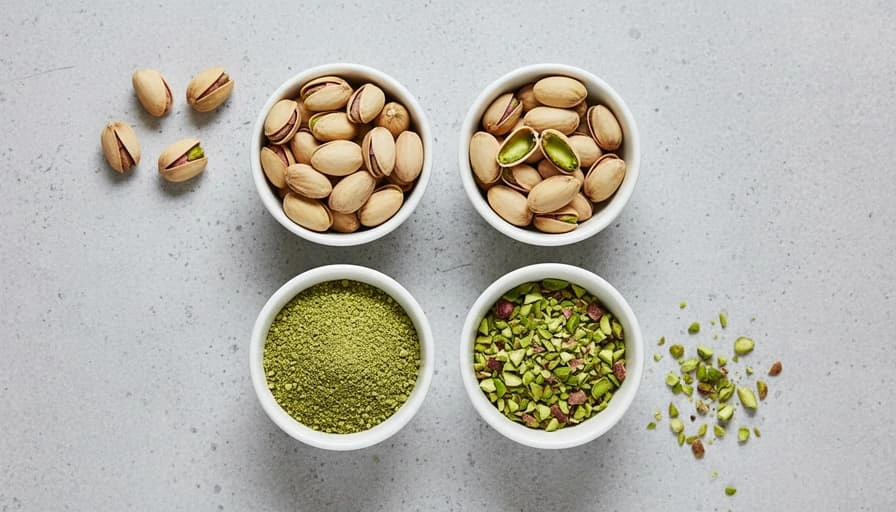
Form changes storage behavior too. The shell gives in-shell pistachios a natural barrier that extends storage life, while shelled and granulated forms oxidize faster and need tighter sealing and cooler conditions. Treating the supplier’s packaging as the first layer of protection, and matching storage to form, keeps quality intact until production. You can review packaging options on our products page.
Common quality mistakes
A few recurring mistakes lead buyers to accept poor quality or unsafe product. Avoiding them is mostly about insisting on evidence rather than relying on appearance or trust alone.
- Relying on visual checks for safety: aflatoxin cannot be seen or tasted, so testing is essential.
- Accepting a mismatched COA: a certificate that does not match the batch, or is outdated, offers little assurance.
- Skipping the sample: committing to volume without evaluating quality first multiplies risk.
- Ignoring storage: poor storage after purchase undoes the quality you paid for.
- Judging quality in the abstract: quality should be assessed against your specific product, not a general standard.
The common thread is that pistachio quality and safety must be verified, not assumed. Combining sensory evaluation, documentation, and proper storage gives you reliable results from one shipment to the next.
Why Alyassin Farms?
At Alyassin Farms, we treat quality and safety as the foundation of wholesale supply, with the documentation that import controls and your own quality standards require. Our family heritage in pistachios dates to the 1970s, beginning with the family’s orchards in Syria, so we understand the product from the source through to how it must be handled and verified.
We supply both Syrian and American pistachios in multiple grades and forms, supported by our office in Seattle and direct relationships with California farms. We work exclusively in wholesale supply for confectionery and chocolate manufacturers, bakeries, and distributors, and provide paid samples with photos and video so you can evaluate quality yourself before committing. Contact us to request a sample and the documentation for your market.
Frequently Asked Questions
What makes a good quality pistachio?
A good quality pistachio has a strong, consistent green color, uniform size, low breakage and foreign matter, appropriate moisture, and fresh flavor with no rancid notes. The right balance depends on the product — visible uses demand higher quality, while fillings tolerate more variation.
What is aflatoxin and why does it matter in pistachios?
Aflatoxin is a natural toxin that can develop in nuts with poor drying or storage. It matters because both the EU and US enforce strict maximum levels, and it is the most common reason pistachio shipments are rejected. It cannot be seen or tasted, so laboratory testing is essential.
What is a certificate of analysis (COA) for pistachios?
A COA is a document confirming that a specific batch meets defined specifications and safety limits, typically reporting moisture, foreign matter, and aflatoxin results tied to a batch number. It should match the exact lot you are buying and be recent to provide real assurance.
How can I tell if pistachios are fresh?
Fresh pistachios have a vivid, even color, a clean and slightly sweet aroma, and a crisp texture with no rancid or stale taste. Off odors, dull color, excess moisture, or a rancid flavor indicate age or poor storage. Documentation and proper storage support freshness.
What documents confirm pistachio quality and safety?
A certificate of analysis (COA), an aflatoxin test report, and a certificate of origin confirm quality, safety, and source, with a halal certificate often requested too. These documents should be batch-specific and agreed with the supplier before shipping.
How does storage affect pistachio quality?
Heat, humidity, light, and air accelerate loss of flavor and color and can cause rancidity. Pistachios should be kept cool, dry, dark, and sealed, with cold storage for large quantities. In-shell pistachios keep longer than shelled or granulated forms, which need closer care.