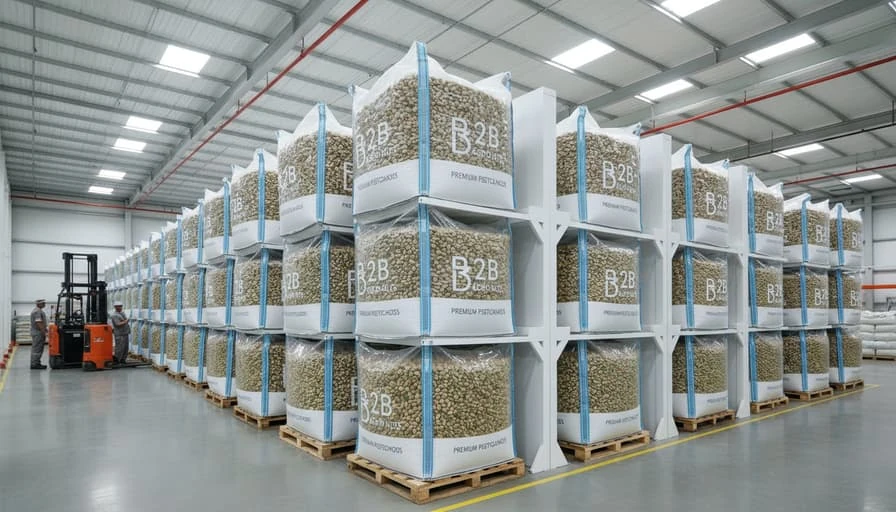
Ingredient cost is one of the biggest challenges facing bakeries and food factories, and pistachios are among the most expensive ingredients of all. That is why bulk pistachio buying is one of the most effective decisions for cutting production costs — it lowers the unit price, stabilizes supply, and improves operational efficiency. The larger the quantity, the better the buying terms and the lower each unit’s share of total cost.
This guide explains how bulk pistachio buying saves costs for bakeries and factories, when it’s the right decision, and how to plan it without waste. If you’re choosing what to buy in volume, it helps to first settle the right origin and grade for each product.
How does bulk pistachio buying save costs?
Bulk pistachio buying saves costs by lowering the unit price as quantity rises, reducing the number of orders and shipping fees, locking in prices against market swings, and securing stable supply. It also improves consistency, because a single large batch is more uniform, and gives the buyer stronger negotiating power with the supplier.
The savings go well beyond the headline price per kilogram. They include indirect costs such as the time spent preparing repeat orders, shipping and clearance fees, and the risk of price swings between shipments. When you look at total cost rather than unit price alone, bulk pistachio buying is usually the more economical route for businesses with steady consumption.
6 benefits of bulk pistachio buying
The benefits of bulk pistachio buying extend beyond a lower price into operational gains that affect profitability. Here are six of the most important:
| Benefit | How it works | Impact |
|---|---|---|
| Lower unit price | Volume discounts cut the per-kg price | Direct reduction in production cost |
| Stable supply | Securing enough stock for longer | Avoids stoppages and sudden shortages |
| Fewer orders | Fewer purchase orders and shipments | Saves on fees and buying time |
| Price locking | Agreeing a price for a set quantity | Protection from market swings |
| Consistency | One batch instead of many | Uniform quality across production |
| Negotiating power | Larger volume earns better terms | Flexibility on price, payment, delivery |
The two most valuable benefits in practice are stable supply and price locking. With global pistachio prices fluctuating, agreeing a quantity at a set price protects your margin from surprises. And because the stock arrives in one batch, you get consistent color, flavor, and size across your products — something that is hard to guarantee with small, repeated orders. Fewer orders also free your team’s time for production rather than purchasing admin.
How to calculate the savings from bulk pistachio buying
To calculate the savings from bulk pistachio buying, compare the total cost per kilogram across order sizes — including purchase price, shipping and clearance, and any expected waste. The option that looks cheapest per kilogram is not always the most economical once these costs are added, and vice versa.
The practical method is to move beyond the listed price per kilogram to the “landed cost” of each kilogram you actually use in production. To estimate it, account for:
- Purchase price: the per-kg price after any volume discount.
- Shipping and clearance: spread across the total quantity.
- Expected waste: any stock that may spoil before use due to poor storage or long holding.
- Storage cost: any extra space or cooling the larger quantity requires.
Comparing this total cost between bulk and frequent small orders reveals the real value of buying in volume, especially when consumption is steady and waste is low.
Bulk vs small-quantity buying
Bulk pistachio buying beats small-quantity buying on unit price, supply stability, consistency, and price certainty, but it requires more storage and cash. Small-quantity buying offers more flexibility and liquidity but costs more per unit and is more exposed to price swings and shortages.
| Criterion | Bulk buying | Small-quantity buying |
|---|---|---|
| Unit price | Lower (volume discount) | Higher |
| Supply stability | High | Variable |
| Orders and fees | Fewer | Frequent and higher |
| Price certainty | Can be locked in | Changes with the market |
| Storage needed | More | Less |
| Consistency | High (one batch) | Varies between shipments |
The takeaway is that neither is simply better; it depends on your size, storage capacity, and cash flow. You can review the forms and quantities available on our products page.
When is bulk pistachio buying the right choice?
Bulk pistachio buying is the right choice when your consumption is steady and relatively large, you have suitable storage and enough cash flow, and your products are stable with consistent recipes. If consumption is small, irregular, or storage is limited, smaller orders may suit you better.
Before committing to a large quantity, confirm these conditions:
- Steady, sufficient use: you’ll consume the stock before it nears the end of its shelf life.
- Suitable storage: a cool, dry space, with cold storage preferred for large volumes.
- Adequate cash flow: the large purchase won’t strain your working capital.
- Stable products: recipes that won’t change in a way that leaves the quantity unsuitable.
On the other hand, bulk pistachio buying may not suit startups with unstable demand, or where storage space or cash flow is limited, because excess quantity can turn from a saving into waste.
Bulk buying amid pistachio price volatility
Amid global pistachio price volatility and rising demand, locking in a price through larger purchases is a way to protect production cost. Agreeing a quantity at a set price in advance reduces your exposure to sudden market spikes and gives you pricing stability.
Pistachio prices have come under clear pressure as demand for pistachio products has surged, which leaves businesses that rely on frequent small orders more exposed to cost swings. By planning ahead and agreeing suitable quantities, you can turn market volatility from a worry into an advantage in pricing stability — a theme explored in our overview of pistachio supply trends in the GCC.
Start with a trial quantity
If you’re working with a new supplier, it’s wise to start with a trial quantity or paid sample before committing to a large bulk order. This lets you evaluate quality, origin, grade, and the supplier’s reliability on specifications and timelines before you tie up working capital in a large quantity.
Once quality and reliability are confirmed, you can scale up order size gradually to reach the best savings. This step-by-step approach reduces risk and builds a long-term relationship that earns better terms over time.
How to plan bulk pistachio buying without waste
To plan bulk pistachio buying without waste, estimate your consumption over the shelf life, store the pistachios cool, dry, and sealed, apply first-in, first-out (FIFO) rotation, and split the quantity across the forms and grades you actually use. This ensures the saving becomes profit rather than spoilage.
Waste is the main enemy of bulk savings, and it can be avoided with practical steps:
- Forecast demand: buy a quantity that matches your expected use, not more.
- Mind form and shelf life: processed forms like granulated last less, as covered in our guide to pistachio forms.
- Store correctly: cool, dry, away from light, and in sealed packaging.
- Use FIFO: consume the oldest stock first to avoid expiry.
- Split by grade: choose the right grade per product to avoid over-buying.
Whatever the quantity, make sure storage meets Saudi Food and Drug Authority (SFDA) food-safety requirements, because proper storage protects the value of the stock you bought.
Common mistakes in bulk pistachio buying
Savings aren’t automatic just because you increase the quantity. Some mistakes turn bulk buying into a loss:
- Buying more than you use: leading to spoilage of part of the stock before use.
- Neglecting storage: poor storage spoils even the best pistachios.
- Focusing on price alone: without confirming quality, origin, and the right grade.
- Not fixing specifications: agreeing a quantity without defining origin, grade, and form in writing.
- Ignoring shelf life by form: buying short-life forms in quantities beyond your needs.
Why Alyassin Farms?
At Alyassin Farms, we specialize exclusively in wholesale pistachio supply for confectionery and chocolate factories, bakeries, and distributors, with a family heritage in pistachios dating to the 1970s. We offer Syrian and American pistachios in multiple forms and grades, with flexible quantities to match your scale and needs.
We help you determine the right quantity, form, and grade for the best savings without waste, and we provide paid samples with photos and video so you can evaluate quality before ordering. Contact us for a quote on the bulk quantity you need.
Frequently Asked Questions
Does bulk pistachio buying really save money?
Yes, for businesses with steady consumption. Bulk pistachio buying lowers the unit price, reduces the number of orders and shipping fees, and locks in price. The saving is only realized with good planning and proper storage that prevent waste.
What is the minimum order for buying pistachios in bulk?
The minimum order varies by supplier and by the type and form of pistachio. It often starts from large standard-weight packs, and custom quantities can be arranged to fit a business’s needs. We recommend contacting the supplier to confirm the right minimum for you.
Does pistachio quality drop when buying in bulk?
No. Quality is tied to origin, grade, and storage, not to order size. In fact, bulk pistachio buying from a single batch can be more consistent in quality than scattered small orders, as long as storage is correct.
How do I store large quantities of pistachios?
Store large quantities in a cool, dry place, away from light and in sealed packaging, with cold storage preferred to extend shelf life. Apply first-in, first-out (FIFO) rotation so the oldest stock is used before the newest.
When is bulk pistachio buying not suitable?
It may not suit small or irregular consumption, limited storage space or cash flow, or recipes that change often. In these cases, excess quantity can turn into waste instead of a saving, so smaller orders may be a better fit.
How do I get a better price when buying in bulk?
Define your quantity clearly and negotiate a fixed price for it, request a sample to confirm quality, and compare offers on total cost rather than price per kilogram alone. A long-term relationship with a reliable supplier earns better terms over time.